Form W-2, Wage and Tax Statement, is an employer’s annual report of your wages, certain benefits and taxes withheld. You use it to prepare your individual return. It is not the return itself, a bill or a promise of a tax refund.
Read the tax year printed on the form first. A 2025 W-2 generally supports a return filed in 2026; a 2026 W-2 generally supports a return filed in 2027. The 2026 form actually changes Boxes 12 and 14, so explanations for different years should not be mixed. Start with the map, then use the box-by-box guide and preparation checklist.
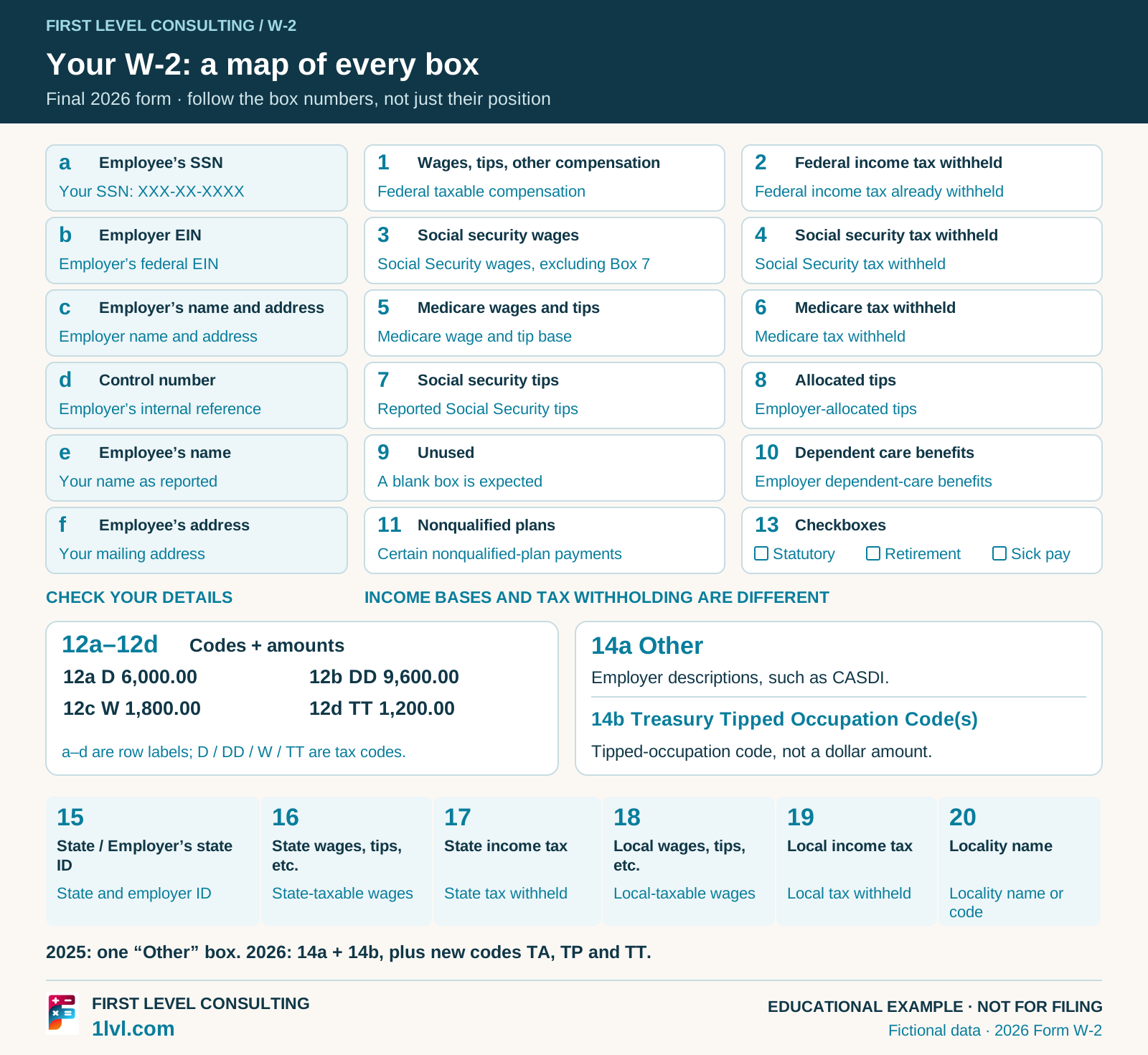
Your W-2 map: find the right part of the form
The left side identifies the employer and employee. The main area reports federal wages, Social Security, Medicare, benefits and special codes. The bottom band reports state and local information. A payroll provider may use a different print layout, but the numbered fields retain their meaning.
The First Level diagrams below are educational illustrations. They do not replace an employer-issued W-2 and are not for filing. They contain no real client information.
Start with the year: what changed for 2026
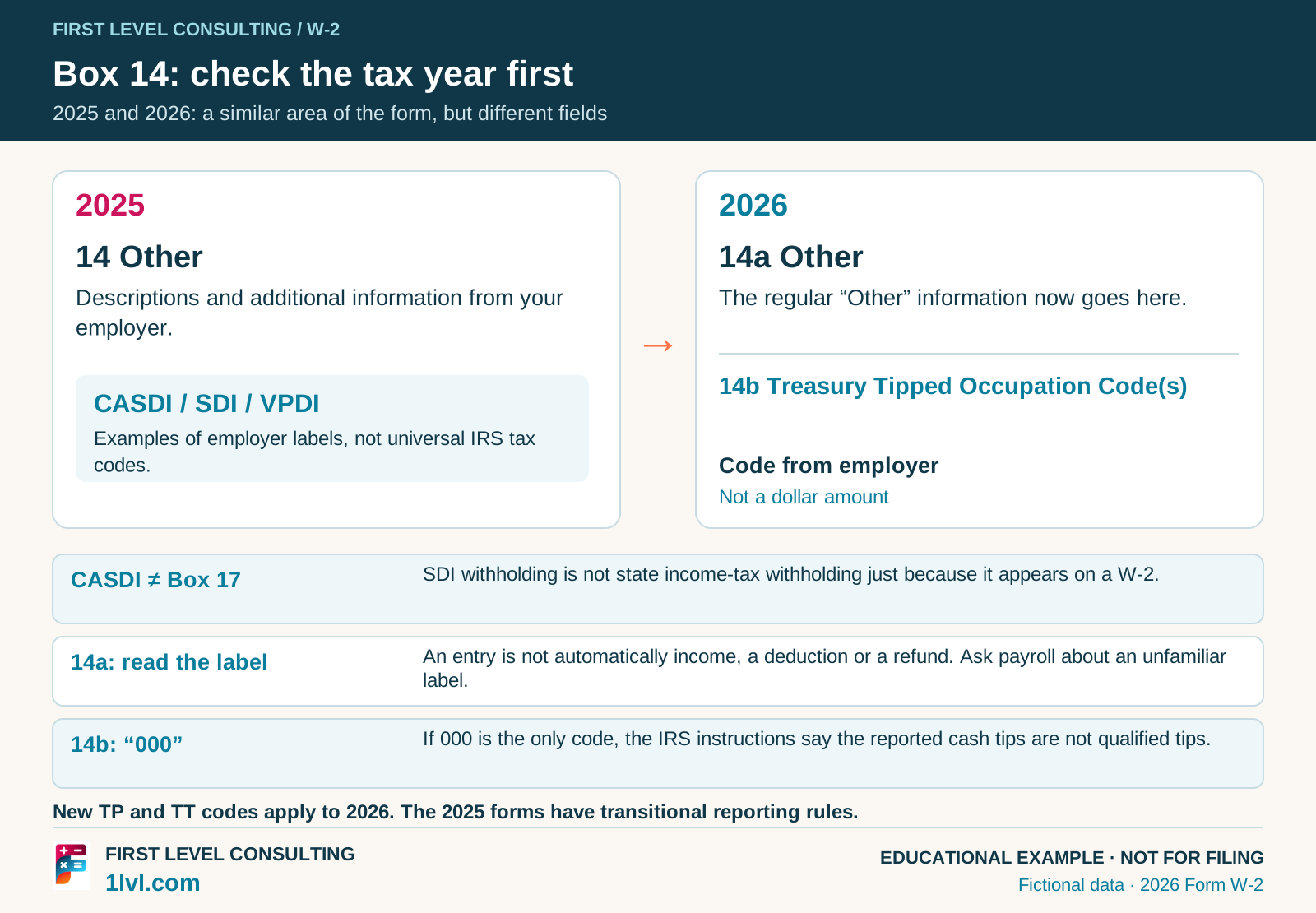
The 2025 W-2 has one Box 14, Other. The final 2026 form splits it into 14a, Other, and 14b, Treasury Tipped Occupation Code(s). Box 12 adds TA, TP and TT for 2026. These are changes to the 2026 form, not a requirement to find those fields on an older W-2.
For 2025, transitional rules allowed supporting tip and overtime information through separate statements or voluntary Box 14 reporting. Missing TP and TT entries do not themselves make a 2025 W-2 wrong. For 2026, use that year’s separate-reporting requirements and give your preparer any missing information and payroll correspondence.
| Tax year | Box 12 | Box 14 |
|---|---|---|
| 2025 | 30 active codes; no TA, TP or TT | One Other box |
| 2026 | 33 active codes, including TA, TP and TT | 14a Other + 14b tipped-occupation code |
Fields a–f: whose form is this?
Check these entries against your records and the employer. A name or SSN error can prevent income from being matched correctly. Do not edit the official PDF yourself: ask payroll or the employer about correction and tell your preparer whether a return has already been filed.
An old mailing address does not necessarily make the tax amounts wrong, but update your address with the employer. If you moved between states, separately provide dates and work locations. A mailing address does not establish the entire state tax situation.
| Field | Meaning |
|---|---|
| a · Employee’s SSN | Your Social Security number. Keep it private and out of ordinary email. |
| b · Employer EIN | The employer’s federal identification number, not your SSN or the state ID in Box 15. |
| c · Employer name/address | The employer’s name and address. |
| d · Control number | An internal payroll reference, which may be blank. It is not another tax identification number. |
| e · Employee name | Your first name, middle initial, last name and suffix, if applicable. |
| f · Employee address | Your mailing address and ZIP code. |
Boxes 1–6: income and taxes already withheld
Box 1 reports federal taxable wages, not the money deposited in your bank account. Eligible pretax benefits may reduce gross pay for this purpose. Taxable benefits can also create wages without a separate cash deposit. Do not add Boxes 1, 3 and 5 together: they are different tax bases, often describing the same compensation.
Withholding is tax paid in advance. The final refund or balance due depends on the complete return, including household income, filing status, deductions, credits and other payments. Box 2 or Box 17 is not automatically the amount of your refund.
| Box | Meaning and useful check |
|---|---|
| 1 · Wages, tips, other compensation | Compensation for federal income-tax purposes. It can differ from gross pay and state wages. |
| 2 · Federal income tax withheld | Federal income tax already withheld. It does not automatically include Social Security or Medicare tax. |
| 3 · Social Security wages | Wages subject to Social Security, within its annual wage base. Social Security tips are reported separately in Box 7. |
| 4 · Social Security tax withheld | Employee Social Security withholding. Multiple employers can require a separate excess-withholding review. |
| 5 · Medicare wages and tips | Wages and tips for Medicare, without the ordinary annual Social Security-style wage cap. |
| 6 · Medicare tax withheld | Medicare withholding, including applicable Additional Medicare Tax withholding. |
Boxes 7–11: tips, care benefits and deferred compensation
Some boxes apply only to particular payments. A blank box is not necessarily an error. Ask payroll to explain an unfamiliar entry and retain the annual pay statement, benefit-plan documents or tip records that support it.
For Box 10, use the right year. The general maximum federal exclusion for qualifying dependent-care benefits rises from $5,000 for 2025 to $7,500 beginning in 2026; for married filing separately, it rises from $2,500 to $3,750. This is not an automatic child deduction: conditions, limitations and Form 2441 matter. The IRS separately corrected a stale $5,000 figure in a paragraph of its 2026 general instructions.
| Box | What it reports |
|---|---|
| 7 · Social Security tips | Reported tips relevant to Social Security. Do not add them again to income already included in wages. |
| 8 · Allocated tips | Tips allocated by the employer under special rules. They are not included in Boxes 1, 3 or 5; tip records and Form 4137 may be needed. Do not simply ignore the box. |
| 9 | Reserved blank field on the current form. Do not supply your own amount. |
| 10 · Dependent care benefits | Total employer-provided care benefits, including applicable dependent-care FSA amounts. It can exceed the allowed exclusion; a taxable portion may already be included in Box 1. |
| 11 · Nonqualified plans | Certain nonqualified-plan distributions or deferred compensation. Supply the plan records and do not add the amount to wages again without review. |
Box 12: read the code, then the amount
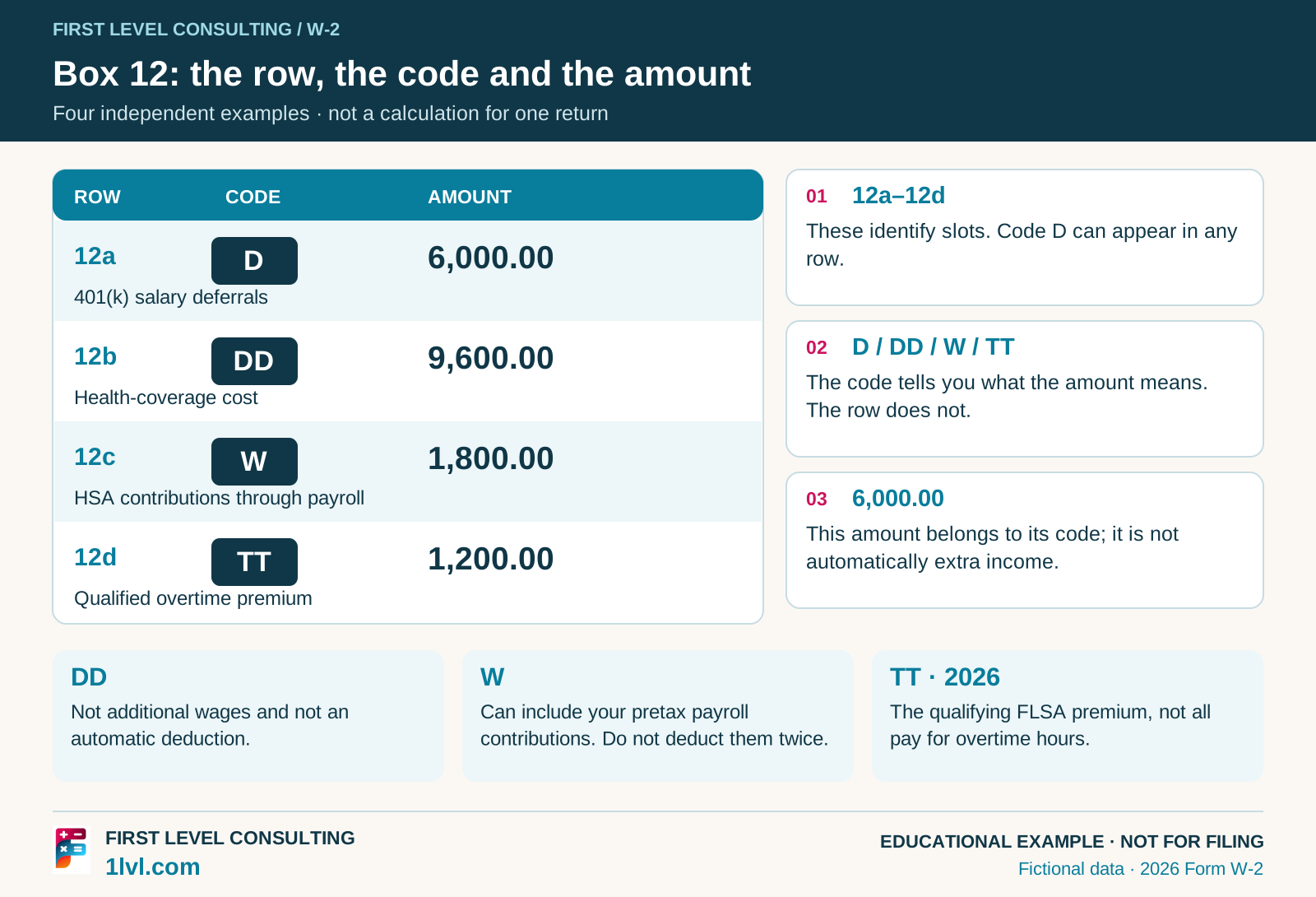
In D 6000.00, D identifies the type of item and 6000.00 is its amount. The small letters in 12a, 12b, 12c and 12d label four spaces on the form. They are not tax codes: code D can appear in any of those spaces. An employer may supply additional pages when there are more codes.
Common entries include D, AA, DD and W. D generally identifies pretax 401(k) deferrals already considered in the relevant wage amount; AA identifies Roth 401(k) contributions with different tax treatment. DD reports health-coverage cost and does not itself create taxable income or a deduction. W includes HSA contributions through pretax payroll: do not claim the same amount again as a separate personal contribution. HSA reporting generally involves Form 8889.
If you changed employers or contributed to several retirement plans, provide every W-2. Certain elective deferrals share an individual annual limit across plans; a new employer does not necessarily create a fresh limit. Different plan types and catch-up contributions have their own rules.
Uncommon codes also matter. A and B can identify uncollected tip taxes; Z concerns a section 409A failure. II applies to certain excluded Medicaid-waiver payments, not automatically all IHSS compensation. Provide the complete W-2 and supporting records instead of removing an unfamiliar amount yourself.
| Code | Meaning on Form W-2 |
|---|---|
| A | Uncollected Social Security / RRTA tax on tips. |
| B | Uncollected Medicare tax on tips. |
| C | Taxable cost of employer group-term life coverage above $50,000. |
| D | Employee salary deferrals to a 401(k), including a SIMPLE 401(k). |
| E | Employee salary deferrals to a 403(b). |
| F | Salary-reduction SEP contributions, including applicable Roth SEP deferrals. |
| G | Reportable employee and employer contributions to a 457(b) plan. |
| H | Contributions to a section 501(c)(18)(D) retirement plan. |
| J | Nontaxable third-party sick pay. |
| K | Excise tax on excess golden-parachute payments. |
| L | Substantiated, nontaxable employee business-expense reimbursements. |
| M | Former employee’s uncollected Social Security / RRTA tax on taxable group-term life coverage. |
| N | Former employee’s uncollected Medicare tax on that coverage. |
| P | Excludable qualifying military moving reimbursements; the 2026 instructions also cover specified intelligence-community employees. |
| Q | Nontaxable combat pay. |
| R | Employer Archer MSA contributions. |
| S | Employee SIMPLE-plan salary reductions, including applicable Roth SIMPLE contributions. |
| T | Employer-provided adoption benefits. |
| V | Income from exercising nonstatutory stock options. Also provide stock-plan and brokerage records. |
| W | Employer HSA contributions, including employee pretax payroll contributions. |
| Y | Deferrals under a section 409A arrangement. |
| Z | Compensation under a noncompliant section 409A arrangement; additional tax may apply. |
| AA | Designated Roth 401(k) contributions. |
| BB | Designated Roth 403(b) contributions. |
| DD | Informational cost of employer-sponsored health coverage. The entry itself creates neither extra taxable wages nor a deduction. |
| EE | Designated Roth contributions to a governmental 457(b) plan. |
| FF | Permitted QSEHRA benefits under a qualifying small-employer health reimbursement arrangement. |
| GG | Income from qualifying section 83(i) equity grants. |
| HH | Accumulated section 83(i) deferred income. |
| II | Medicaid-waiver payments excluded under Notice 2014-7. Eligibility depends on the facts. |
| TA | New for 2026: qualifying employer Trump-account contributions. |
| TP | New for 2026: total cash tips reported to the employer, including charged and tip-sharing tips. |
| TT | New for 2026: qualified overtime compensation, the qualifying premium above the regular rate. |
New TP and TT: a reported amount is not an automatic deduction
For 2026, TP reports total cash tips disclosed to the employer. Cash tips include applicable cash, charged and tip-sharing tips. TP does not promise a deduction for the complete amount: the payment, occupation code, individual limits and other requirements need review. A mandatory service charge does not become a voluntary tip merely because of its payroll label.
TT reports qualified overtime compensation. For ordinary time-and-a-half pay, this concerns the qualifying extra half required by the FLSA, not all compensation paid for overtime hours. For example, with a $20 regular rate and $30 paid for a qualifying overtime hour, the premium considered is $10, not the entire $30. An overtime label on a California pay statement does not itself establish the federal deduction.
Tips and overtime remain reportable income and generally remain subject to applicable payroll taxes. For 2026, ask the employer to correct an omitted or understated TT amount: an independent pay-stub calculation does not replace required separate reporting. The dedicated guides explain the limits and records in more detail.
Box 13: three checkboxes with different meanings
Statutory employee identifies a particular tax category. It is not a general synonym for employee or independent contractor. The checkbox can affect how income and expenses are reported; show the preparer the form and work facts.
Retirement plan identifies participation in a relevant employer plan and can affect the deductibility of a traditional IRA contribution, depending on income and family circumstances. Third-party sick pay identifies certain sickness payments from another payer. None of these checkboxes by itself establishes disability status, a tax credit or the final return result.
Box 14 / 14a: employer descriptions, not a universal IRS dictionary
For 2025, find Box 14, Other; for 2026, find Box 14a, Other. Employers may report labels such as CASDI / SDI, VPDI, union dues, after-tax retirement contributions, certain fringe benefits or other information. Similar abbreviations from different employers do not always receive identical tax treatment.
In California, CASDI commonly refers to State Disability Insurance and VPDI to a relevant voluntary disability plan. These are not the California income-tax withholding reported in Box 17. Do not add them to state income-tax withholding or treat every Other entry as a deductible expense. Establish the actual payroll category before selecting a special entry in tax software.
New 2026 Box 14b reports a Treasury Tipped Occupation Code, not a dollar amount or state code. If the only code is 000, the employee instructions say the reported cash tips are not qualified tips for the deduction. When several codes appear, records are needed to separate the tips associated with them.
Boxes 15–20: the state and local section at the bottom
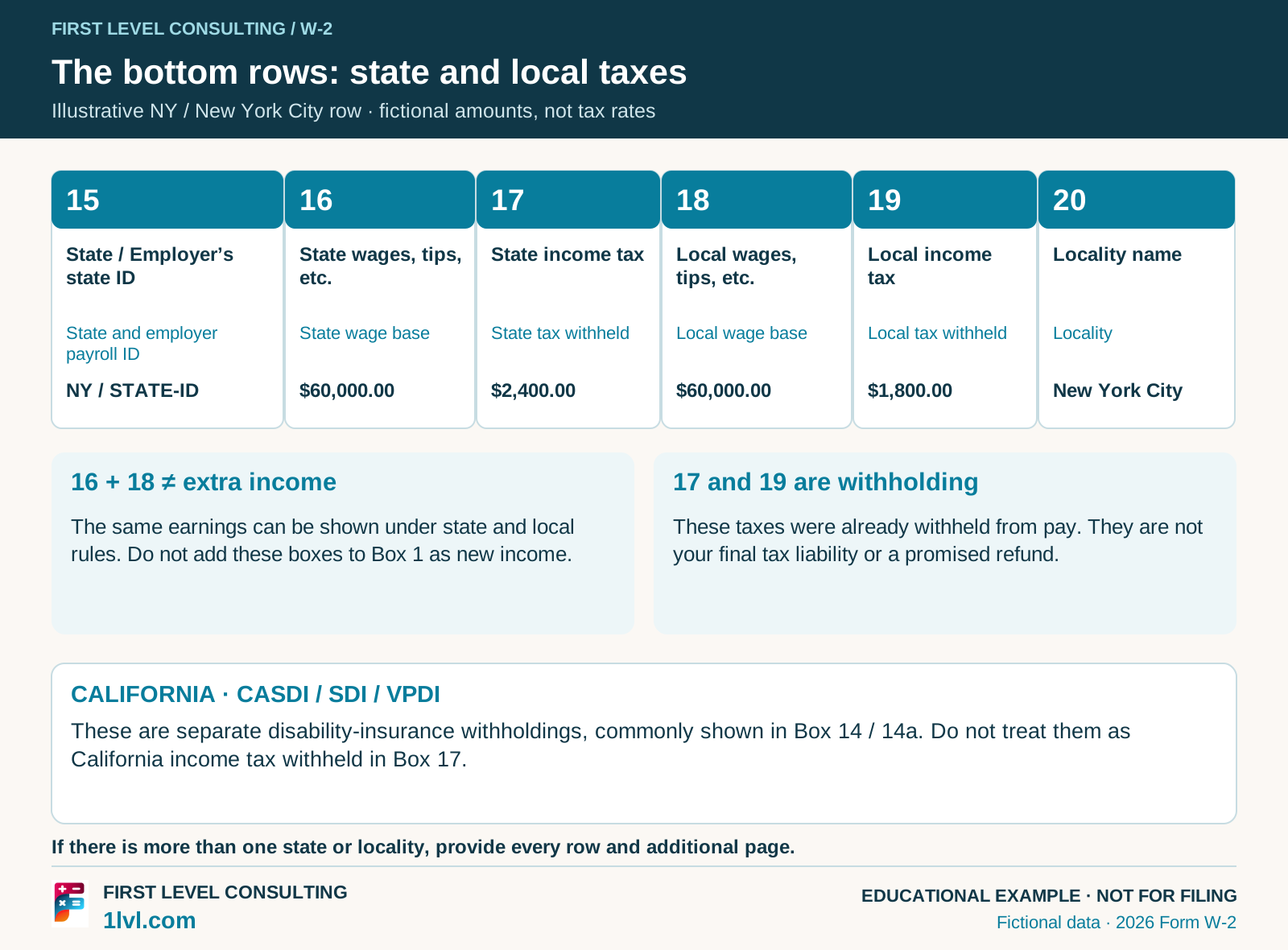
Read the bottom band one row at a time. An employee can have several states, work locations or additional pages. State wages and local wages are not new payments on top of federal wages. The same compensation can be included in several tax bases.
Box 17 does not promise a refund or show final state tax liability. Box 19 reports the particular local withholding. Empty local fields can be normal. A second state row does not itself prove that two full taxes are due or that an Other State Tax Credit automatically applies.
If you lived in one state and worked in another, moved or worked remotely, provide dates, physical work locations, all W-2 rows and a workday calendar when available. An other-state credit depends on the relevant states’ rules and income facts; it is not simply the withholding in the other row.
| Box | Plain explanation |
|---|---|
| 15 · State / employer’s state ID | Two-letter state abbreviation and the employer’s state registration number, not the employee’s SSN or necessarily the federal EIN. |
| 16 · State wages, tips, etc. | Compensation for that state’s income-tax rules. It may differ from Box 1. |
| 17 · State income tax | Income tax withheld for the named state, not CASDI/VPDI or another state’s tax. |
| 18 · Local wages, tips, etc. | Compensation in a local tax base, often part of or another base for the same wages. |
| 19 · Local income tax | Local income tax withheld for the relevant row. |
| 20 · Locality name | The name or code identifying the local taxing jurisdiction. |
If a form is missing or appears wrong
Check the payroll portal, your mail and the tax year, then contact the employer. Identify the questionable entry: SSN, name, wages, state, code or missing statement. Do not manufacture a new W-2 or substitute a bank-deposit screenshot.
Form W-2c corrects certain information on an issued W-2. Give your preparer both the original and correction, clearly identifying the newer version. Do not combine them as income from two employers. Tell the preparer before taking further action if a return has already been filed.
When contacting the employer does not resolve a missing or incorrect form, the IRS has a specific assistance procedure and Form 4852. A substitute statement and any subsequent amendment require review. Raise the issue before the filing deadline is imminent.
What to send First Level for return preparation
Gather the correct year’s W-2 from every employer, every additional page with states or codes, W-2c corrections and a list of missing forms. Federal, state and employee copies of one W-2 do not represent three separate incomes. A separate employer or year still must not be omitted.
Provide moves, work in other states, disputed benefits, tips and overtime records. Include relevant documents for employer stock, HSA, dependent-care benefits or Medicaid-waiver payments. W-2 and Form 1099 describe different relationships; receiving one does not rule out other work or income.
A W-2 contains your SSN, income and other personal information. Use only your assigned secure channel: agreed TaxesToGo access or an individual Egnyte invitation. A first question needs only the document name, year and a short description, without an SSN or complete form attached to ordinary email.
What to prepare for a discussion
- The correct year’s W-2 from every employer, with all pages
- Original and W-2c forms, identifying any already-filed return
- Checked name, SSN and employer details
- Every Box 12 and 14 / 14a / 14b entry, without cropped photo edges
- The complete 15–20 band for all states and localities
- Move dates and physical or remote work locations
- Relevant HSA, care, stock, tip and overtime records
- Missing-form list and the assigned secure delivery channel
Questions and answers
Box 1 is lower than my annual salary. Is it wrong?
Not necessarily. Pretax 401(k) deferrals and certain benefits can affect federal taxable wages. Compare the full annual payroll record rather than net deposits alone.
Should I add Boxes 1, 3 and 5 together?
No. They are different tax bases, often for the same wages. Adding them generally overstates income.
Is Box 12 code DD money I can deduct?
DD is informational health-coverage cost, not an automatic deduction or extra wages.
Why does my 2025 W-2 have no TP, TT or 14b?
Those fields and codes were introduced for 2026. The 2025 transition has its own reporting and documentation rules.
Does CASDI in Box 14 mean California income tax?
No. Do not combine CASDI/VPDI with Box 17 income-tax withholding. First identify the actual type of payment.
They withheld $4,000. Will my refund be $4,000?
Not automatically. Withholding is credited against tax calculated on the entire return, which may produce a refund or balance due.
Do I need the W-2 if I can see wages in a payroll app?
Download the complete annual tax statement. A last-paycheck screen may not show final annual figures, every code or every state/local row.
Official sources
- IRS — 2026 Form W-2 and employee instructions www.irs.gov
- IRS — 2025 Form W-2 and employee instructions www.irs.gov
- IRS — 2026 General Instructions for Forms W-2 and W-3 www.irs.gov
- IRS — correction to the 2026 dependent-care benefits exclusion www.irs.gov
- IRS — 2025 transition for tips and overtime reporting www.irs.gov
- IRS — qualified overtime FAQs, FS-2026-13 www.irs.gov
- IRS — missing or incorrect Form W-2, Topic 154 www.irs.gov
- California FTB — withholding entries, including SDI and other-state amounts www.ftb.ca.gov
- California FTB — Other State Tax Credit www.ftb.ca.gov