An agent may have commission income, wages from an owned S corporation and rental properties at the same time. These income streams have different records and tax rules. Useful planning starts with separate accounting and a clear question: which expense or tax are we trying to address?
A real estate license, S election or rental purchase does not by itself make a rental loss deductible against wages. This guide explains the sequence of checks and the documents needed to evaluate an actual strategy. Sources were checked November 16, 2026. Forms, limits and state rules must be matched to your tax year.
Identify who earns the commissions
Record the legal payee, tax classification, ownership, brokerage and effective dates of any structural change. If you earned commissions personally for part of a year and through an entity later, preserve separate periods and accounts. An individual 1099 cannot simply be moved to a new corporation without reviewing the contract, payee and work performed.
Qualifying licensed real estate agents can be statutory nonemployees for federal tax purposes when substantially all compensation is linked to sales or output and a written contract provides nonemployee treatment for federal taxes. Other arrangements require a classification review. A job title or receipt of a 1099 is not the whole analysis.
S corporation treatment is a tax classification subject to eligibility and election rules. It does not replace professional licensing. Before changing commission payees, coordinate with the responsible broker and an appropriate licensing adviser. California DRE has separate corporate licensing requirements for entities conducting brokerage activities.
Ask for annual brokerage reports as well as Forms 1099
Collect every issued 1099, annual commission statement and itemized deduction report. There is no universal download menu across brokerages. Ask for a full calendar-year report for each payee showing commission splits, referral fees, desk and transaction fees, reimbursements and corrections. Keep PDF and any available CSV or Excel export.
Reconcile gross commissions, amounts retained by the broker, payments to other participants and bank deposits. A closing statement, annual statement and 1099 may document the same commission. Do not add them as separate receipts. If a statement already reports only your commission share, do not add or deduct someone else’s share without reconciling the report.
Identify referral income, property-management income and other business lines separately. Client deposits, trust-account money, transfers of your own funds and loan proceeds should not automatically be called commission revenue. Explain unusual transactions and provide the supporting records.
| Record | What to check |
|---|---|
| Forms 1099 and corrections | Payee, EIN/TIN, year, amount and reconciliation to books. |
| Annual commission / transaction report | Gross, splits, referral and brokerage fees, deductions and adjustments. |
| Bank and credit card records | Receipts, payments, transfers and reimbursements explaining differences. |
| Payroll and owner transfers | W-2, payroll reports, distributions, contributions and shareholder loans separately. |
Group costs in practical expense categories
Enter your business’s expenses and their business portion. Add a brief explanation and support for large or unusual amounts. A brokerage deduction and a card payment for the same cost are not two deductions. Keep rental-property expenses out of the agency business.
Collect advertising, professional subscriptions, MLS and association dues, E&O insurance, CRM, listing photography and staging services, office costs, phone and assistants. A category in an organizer is a place to collect facts; it does not independently establish deductibility.
| Category | Records or explanation |
|---|---|
| Broker, referral and transaction fees | Annual breakdown, recipients and whether the report already includes them. |
| Advertising and listings | Lead platforms, photos, video, website and print; distinguish nonbusiness spending. |
| MLS, memberships, licensing and education | Invoices; entering a new profession and maintaining existing skills require different analysis. |
| Gifts and business meals | Recipient or attendees, date, business purpose and full amount; limits are reviewed separately. |
| Assistants and transaction coordinators | Agreements, amounts, W-9 or payroll records and worker classification. |
| Phone, internet, CRM and office | Total cost, business share and reimbursements. |
Keep vehicle, home-office and asset records
For each vehicle provide a mileage log, total and business miles, business-use start date, purchase or lease documents, personal use and the prior expense method. Record showings, inspections and client trips with their business purpose. A home-to-permanent-workplace trip does not become business mileage merely because you work in real estate.
List computers, cameras, furniture and other equipment with cost, purchase and placed-in-service dates, business use and prior depreciation. Do not also deduct the entire purchase as an operating expense when it is already listed for asset review. Include disposition documents for sold or retired assets.
For a home office, collect area, use and expense facts. An S corporation owner should discuss documented reimbursement through the corporation rather than assume a personal deduction. Do not enter one amount as a reimbursement, a separate company expense and a rental-property cost.
What an S corporation can change
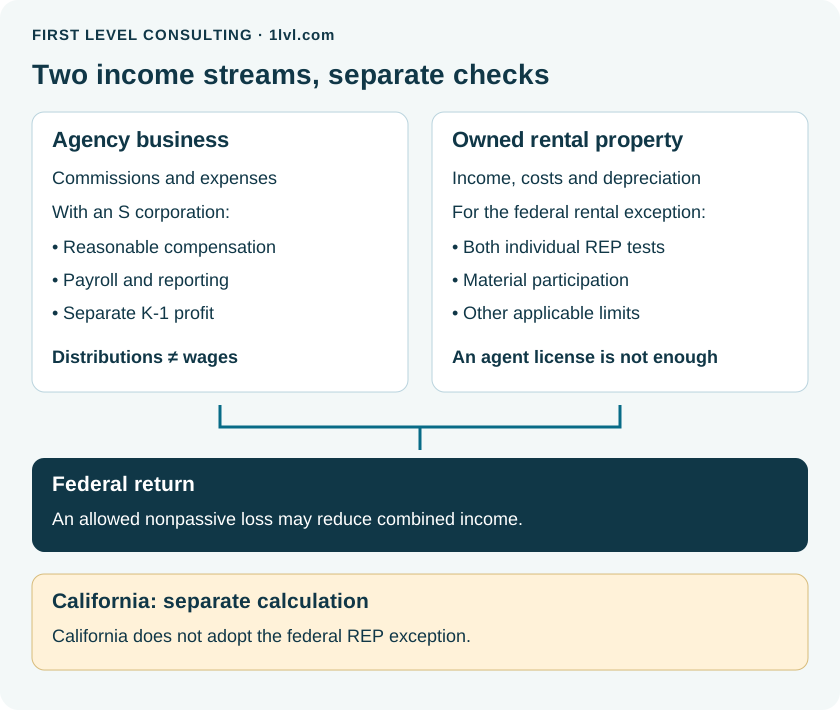
With an eligible structure and valid S election, the business keeps its own books, files an entity return and provides the owner a Schedule K-1. An owner who works for the company receives reasonable wages through payroll. Remaining business profit and cash distributions are different figures; K-1 income is not the amount withdrawn from the bank.
Potential savings concern properly characterized compensation and amounts that are not wages subject to employment taxes. This does not permit classifying almost all personal-service commissions as distributions. The IRS examines duties, time, experience, comparable pay and the source of company revenue. An agency business driven by the owner’s personal services needs particular care.
Prepare a description of prospecting, showings, negotiations, closings, team management and administrative work. Include time and comparable compensation information. There is no universal safe salary or automatic “60/40” rule. Non-wage payments may be reclassified as compensation.
Compare the overall result after corporate costs
A meaningful comparison needs profit before owner compensation, reasonable salary, employer payroll taxes, payroll service, bookkeeping, entity-return preparation and state taxes. Retirement plans, health insurance and other facts can also affect the result. Savings in one tax may be smaller than the additional operating costs.
An illustrative allocation: profit before owner salary and additional corporate costs is $160,000; reasonable salary supported by the assumed facts is $90,000; employer payroll and additional administration together cost $12,000. That leaves $58,000 of preliminary corporate profit. This is not a guaranteed cash distribution or a tax-savings calculation. Taxes, basis and other limitations still need review.
For California, account for the generally applicable 1.5% S corporation tax and $800 minimum franchise tax, subject to relevant exceptions. Do not mechanically add 1.5% and $800 as two equivalent taxes. Income or activity in other states may create additional filing or tax obligations.
Real estate professional status requires both annual tests
For the federal rental exception, one individual must perform more than 750 hours of services in real property trades or businesses in which that individual materially participates, and those services must exceed half of all personal-service time in all trades or businesses during the tax year. Exactly 750 hours is insufficient. Passing only one test is insufficient.
Brokerage can be a real property trade or business. However, employee services count as real-property services for this purpose only when the more-than-5% employer-ownership rule is met. An agent employed by an owned corporation and an employee of an unrelated brokerage can therefore have different outcomes. Ownership percentages and dates matter.
On a joint return, one spouse must independently satisfy both thresholds. Combining one spouse’s 500 hours with the other spouse’s 400 does not qualify either person. Spousal work may be relevant differently to material participation, a separate analysis. A license, association membership or professional job title is not a substitute for these tests.
Next establish participation in the rental activity itself
Passing the real estate professional tests does not make every rental loss nonpassive. The next question is material participation in the particular rental activity. Brokerage work can help establish the person’s qualification without automatically proving participation in managing an owned rental.
There are several defined material participation tests. One uses more than 500 hours; others consider the extent of your work and other people’s participation. If a property manager performs most operations, collect what you, your spouse, the manager and other workers actually did. A single “I manage my property” answer does not establish the applicable test.
Each rental real estate interest is generally a separate activity. A qualifying taxpayer may elect to treat rental interests as one activity. That election has continuing consequences, including when properties are sold; properties are not automatically combined. Provide any prior election statement and the filed returns showing its treatment.
Nonpassive losses still face other limitations
First substantiate the rental result itself: rents, costs, personal use, land and building allocation, placed-in-service dates, improvements and depreciation. Mortgage principal is not an operating deduction merely because it uses cash. Cost segregation or accelerated depreciation requires a separate review and does not automatically make the resulting loss usable.
Applicable limitations include basis for pass-through interests, at-risk limits and passive activity rules, followed by the applicable excess business loss limitation. Old suspended passive losses do not all become deductible simply because the owner qualifies as a real estate professional in a later year. Their history and character must be reviewed.
Federal and state depreciation schedules and carryovers can differ. Preserve the acquisition, improvement, deduction and eventual disposition history. Depreciation can affect a later sale; evaluate current deductions with their future consequences rather than in isolation.
When a rental loss may reduce other income
Assume a household has $90,000 of wages and $60,000 of nonpassive S corporation profit, totaling $150,000 before the rental result and other adjustments. Its substantiated current rental loss after expenses and depreciation is $30,000. For this comparison assume no other passive income, no available special rental allowance and no other applicable restriction.
Without an applicable exception, the passive loss is carried forward under these assumptions and the income shown remains $150,000. If one spouse actually meets the real estate professional tests, material participation is established and the current loss survives the remaining limits, the federal result from these three sources may instead be $120,000.
The W-2 salary remains $90,000. A rental loss does not reduce wages subject to Social Security or Medicare, and does not eliminate reasonable-compensation obligations. A $30,000 income deduction is not $30,000 of tax savings. Actual tax depends on the complete return, and California requires its own calculation.
| Illustrative item | Loss remains passive | Loss allowed as nonpassive |
|---|---|---|
| W-2 wages | $90,000 | $90,000 |
| S corporation profit | $60,000 | $60,000 |
| Current rental loss used now | $0 | $30,000 |
| Result from these sources before other adjustments | $150,000 | $120,000 |
California may not allow the same federal offset
California does not adopt the federal real estate professional rental exception under IRC 469(c)(7). Rental real estate treated as nonpassive federally under that exception can remain passive for California. Having an agent license or S corporation does not remove the difference.
Track federal and California passive-loss carryovers separately. Provide FTB 3801 and supporting worksheets, federal Form 8582, Schedule E and depreciation schedules. The state’s allowed amount can depend on passive income and other applicable rules. Do not automatically carry the illustrative $120,000 federal result into a California calculation.
Track work by person, date and property
A useful entry identifies the date, person, business or property ID, task, hours and support such as a calendar entry, email, invoice or work order. Separate brokerage, each rental and work outside real estate. Do not count one meeting in full against several properties.
The more-than-half test also needs the denominator: personal-service time in other businesses and employment. Rental participation analysis may need manager and other worker information. Passive investment monitoring and every trip should not automatically become qualifying hours. Mark uncertain entries for review.
The IRS allows reasonable ways to substantiate participation; a daily log is not the sole possible proof. Nevertheless, regular records and retained calendars provide a clearer history than identical hour estimates invented at year-end. The organizer collects facts and does not issue a final status determination.
Keep the agency business separate from rental properties
This guide is not a recommendation to transfer rental property into an agency S corporation. Ownership, financing, exit, disposition and legal protection need separate tax and legal analysis. Do not change title or commission payees to obtain a single deduction.
Use the specialized organizer for the agency business and a separate rental organizer for each property, identifying owners, percentages and entities. Corporate books, balance sheets, payroll and K-1 information remain necessary: an intake spreadsheet is not a substitute for Form 1120-S.
New clients need the latest complete filed returns, preferably two years: individual and relevant entity returns, federal and state schedules, depreciation, basis records, loss carryovers and elections. Use the secure channel assigned by our team, TaxesToGo or your personal Egnyte link, including for a scope and fee estimate. Do not attach completed organizers or tax documents to your initial email or SMS.
What to prepare for a discussion
- Legal payee, EIN, classification, S election, ownership percentages and dates, and brokerage agreement.
- All issued 1099s and corrections, annual gross-commission and broker/referral-fee reports, and bank reconciliation.
- Expenses, reimbursements, mileage log, home-office facts and asset register with prior depreciation.
- For an S corporation: books, balance sheet, W-2/payroll reports, employer taxes, distributions, contributions and shareholder loans.
- For each rental: separate organizer, owners and percentages, personal use, contracts, acquisition, improvements and depreciation.
- Each spouse’s time records, other employment and business work, managers’ work and any prior rental-grouping election.
- Complete prior filed returns and federal and California passive, basis and at-risk carryovers with supporting worksheets.
Questions and answers
Does an agent license automatically establish real estate professional status?
No. The federal rental-loss exception has separate annual hours, time-percentage and material participation requirements. The job title alone is insufficient.
Can a rental loss offset my spouse’s wages?
On a joint federal return, an allowed nonpassive rental loss may reduce combined income that includes a spouse’s wages. One spouse must independently meet the REP tests, and rental participation and other limits still need review.
Do hours stop counting if my owned S corporation gives me a W-2?
Employee services are subject to a more-than-5% employer-ownership rule. Actual ownership and dates, the services and material participation matter. A W-2 alone does not answer the question.
Can I choose a very small salary and distribute the rest?
Pay must reasonably reflect the services performed. There is no fixed permitted percentage, and the IRS can reclassify payments. Compare structures using payroll taxes and all additional costs.
Do I need an S corporation to use real estate professional rules?
No. The agency business’s tax classification and the treatment of rental losses are separate issues. The rental tests can be considered without an S corporation.
Does California allow the same rental loss offset?
Not automatically. California does not adopt the federal REP exception. A separate state passive-loss calculation and carryover history are needed.
Why do I need a rental organizer as well as the agent workbook?
Commission operations and owned rentals have different income, expenses, assets and limits. The agent organizer collects business, payroll and participation facts; each rental’s financial records are collected separately.
Will the workbook calculate my S corporation tax savings?
It organizes inputs and a preliminary result from your records. Reasonable salary, tax savings, REP status and allowed rental losses require review of the full situation.
Official sources
- IRS — statutory nonemployees, including qualifying licensed real estate agents www.irs.gov
- IRS — licensed real estate agents: real estate tax tips www.irs.gov
- IRS Publication 334 — business income and expense records www.irs.gov
- IRS Publication 463 — travel, gifts, car expenses and records www.irs.gov
- IRS Publication 946 — depreciation and asset records www.irs.gov
- IRS — S corporations and election requirements www.irs.gov
- IRS — S corporation reasonable compensation and medical insurance www.irs.gov
- IRS — S corporation employees, shareholders and corporate officers www.irs.gov
- IRS — S corporation stock and debt basis www.irs.gov
- IRS Publication 925 — passive activities, participation and real estate professionals www.irs.gov
- IRS Publication 527 — residential rental property www.irs.gov
- IRS — Schedule E instructions, real estate professional tests and rental election www.irs.gov
- 26 CFR 1.469-9 — qualifying taxpayers, spouses and rental grouping www.ecfr.gov
- IRS — Form 8582 instructions, material participation and passive loss limits www.irs.gov
- IRS — Form 461 instructions, excess business loss limitation www.irs.gov
- California FTB — S corporations, franchise tax and filing requirements www.ftb.ca.gov
- California FTB — Form 3801 instructions: California does not adopt the federal real estate professional exception www.ftb.ca.gov
- California DRE — corporation licenses and qualified broker-officers www.dre.ca.gov