“I owe the IRS and cannot pay everything today” starts an investigation, not one automatic relief program. One person may need an ordinary payment plan, another a temporary hardship arrangement, and another correction of an inaccurate assessment. Tax relief and tax resolution describe different procedures, not a promise that tax will disappear.
Start with three questions: is the amount correct, is there an urgent collection action, and what can you realistically pay after necessary expenses? You do not need to receive a letter before asking for help. A known balance, missing returns or a developing current-year shortfall can be reviewed in advance. Use this roadmap to select the detailed guide and prepare for a focused discussion.
Establish which balance actually exists
Identify the agency, taxpayer, tax year and type of tax. An owner’s Form 1040 balance, a corporation’s liability and payroll tax debt belong to different accounts. The IRS, California FTB, EDD, CDTFA and cities also administer different obligations. Resolving one account does not establish that all others are clear.
Collect the return, account transcript, payment confirmations and complete notices. A balance may involve a missing payment, proposed adjustment, unfiled return or inaccurate information. Review correctness before selecting a payment program: an application for affordable payments is not necessarily the procedure for disputing the underlying tax.
If a bank account, wages or appeal deadline is affected
Find the exact notice number and action date. A bank levy, wage levy, Notice of Federal Tax Lien and ordinary balance-due notice are different events. The same debt amount does not create identical deadlines or appeal rights.
For active collection or an approaching deadline, promptly contact the agency through a verified channel or an appropriately authorized professional. Requesting a consultation, messaging an accountant or opening a website form does not itself stop collection. Do not assume that every call or pending request supplies protection; the relevant procedure determines what applies.
Compare the task rather than an advertised discount
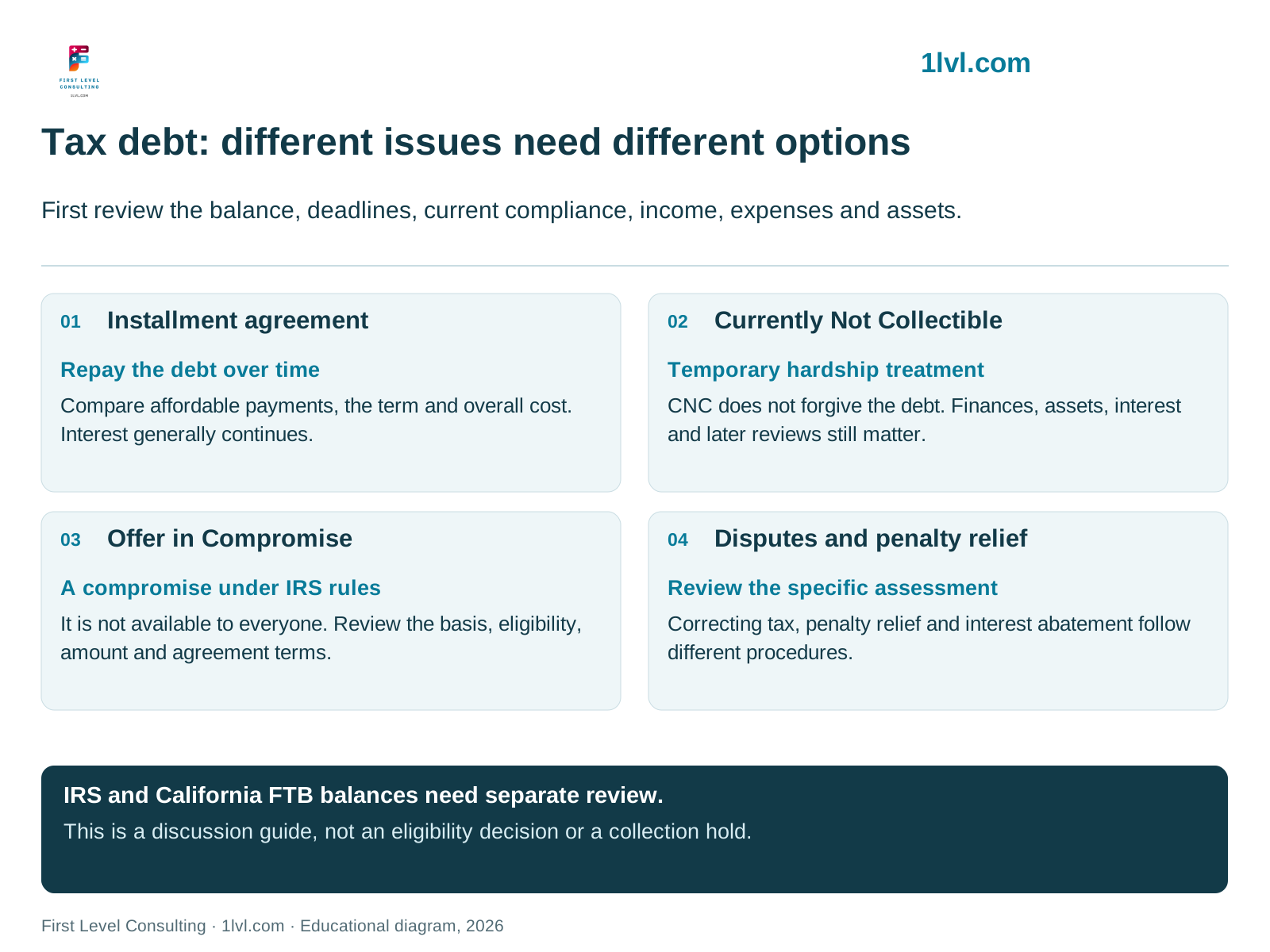
Full payment, affordable installments and settlement solve different problems. These are directions to investigate, not an automated eligibility decision. Income, necessary expenses, assets, current compliance and the remaining collection period can materially change the appropriate choice.
| Situation | Option to review | What it does not establish |
|---|---|---|
| The balance is correct and can be paid | Full payment with the correct period and designation | That any transfer was correctly credited |
| You can repay over time | Installment Agreement / Payment Plan | Frozen interest or any requested monthly amount |
| Some ability to pay, but not full repayment | Partial Payment Installment Agreement | An agreed upfront write-off of the remainder |
| Payment prevents necessary living expenses | Currently Not Collectible (CNC) | Debt forgiveness or a permanent status |
| Facts support a compromise | Offer in Compromise (OIC) | Everyone can settle for pennies on the dollar |
| A penalty may qualify for relief | Administrative relief / reasonable cause | Cancellation of the underlying tax and all interest |
| The liability itself is incorrect | The applicable correction or dispute process | That a payment-plan request will resolve the dispute |
Build a realistic budget and asset picture
List household income, necessary expenses, account balances, property and related loans. For self-employment, distinguish gross receipts, business expenses and funds available to the owner. A platform’s gross receipts are not automatically the household’s disposable income.
The IRS may apply collection standards and request a Form 433 financial statement. These expenses are reviewed for collection purposes; they are not a list of income-tax deductions. A mortgage, retirement account or vehicle cannot simply be left out without reviewing the applicable treatment. Incomplete information can produce an unsuitable request and avoidable delays.
Prevent new debt while resolving the old balance
Determine which returns must be filed and review withholding, estimated payments and applicable payroll deposits. Budget for old debt and current obligations at the same time. A common mistake is agreeing to the highest possible old-debt payment and leaving nothing for the current year.
If returns are missing, identify the periods and reconstruct the records. A relief request does not replace required filing. The same arrangement does not automatically fit an individual balance, an operating business and taxes withheld from employees. A useful plan accounts for all obligations, rather than only the last letter received.
Check current rules, particularly the 2026 changes
The IRS updated Simple Payment Plans for individuals and businesses. It is no longer accurate to assume that every available arrangement is confined to an older 72-month framework; review the actual program and remaining collection period. A longer term generally increases the interest and penalties incurred.
The 2026 transition from First Time Abate to Automatic Exemption from Penalty also affects eligible returns. It does not mean every business’s first penalty automatically disappears. Check the penalty type, period, compliance history and actual account treatment. The detailed guides explain the transition and its limits.
Treat California FTB balances separately
An IRS agreement does not establish a payment plan or cancel a California FTB balance. The state uses its own forms, eligibility criteria, collection rules and hardship procedures. Do not automatically apply federal amounts, dates or procedures to California.
Maintain a separate agency-by-agency list: taxpayer, period, balance, latest action, existing arrangement and next deadline. This is particularly helpful when federal and state letters arrive together. Prepare both records sets so resolving one issue does not cause a missed obligation elsewhere.
Find help and assess a firm’s proposal
Some matters can be handled directly through the official IRS account, the agency’s published contact number or a payment program. Disputes, hardship, multiple periods and active collection may need individual work. Independent Low Income Taxpayer Clinics assist eligible taxpayers, while the Taxpayer Advocate Service has its own assistance criteria.
Before paying professional fees, ask who evaluates eligibility, who performs the work, what authority is needed, what the fee includes and which actions remain your responsibility. Do not choose a program only because of settlement advertising. A careful initial review may establish that an ordinary installment agreement or another procedure is more suitable than an OIC.
A practical first step
Prepare a short list of agencies, taxpayers, years, known balances and return-filing status. Separately identify collection actions, deadlines and earlier arrangements. Mark missing information rather than guessing.
To contact First Level, choose the service and leave a reply contact in the short inquiry form. After contact, the team clarifies urgency and assigns a secure records channel. Scope, fees, the professional’s authority and any representation engagement are separately agreed. Share tax files, full identifiers and banking details only through that assigned channel, rather than a public inquiry.
What to prepare for a discussion
- Agency, taxpayer, tax years and type of tax.
- Complete notices, deadlines and active collection actions.
- Account transcripts, returns and payment confirmations.
- Missing returns and current estimated payments, withholding or deposits.
- Income, necessary expenses, assets and related debts.
- Previous installment plans, appeals, offers and agency decisions.
- Separate IRS and FTB records and the assigned secure channel.
Questions and answers
Does tax relief always mean a debt write-off?
No. It includes balance verification, payment arrangements, separate penalty relief, hardship and other procedures. Establish the facts before selecting an option.
Can I ask for help before receiving a notice?
Yes. Known balances, filing obligations and missing returns can be reviewed in advance. For urgent collection, the actual document and deadline matter.
Does everyone qualify for an Offer in Compromise?
No. Program criteria, assets, ability to pay, compliance and the request’s basis matter. A preliminary tool does not guarantee acceptance.
Are CNC and a partial-payment agreement the same?
No. CNC concerns temporarily limiting collection in qualifying circumstances; a PPIA involves payments and periodic financial review. The specific account determines what applies.
Does an installment agreement stop interest?
Generally no. Applicable interest and penalties can continue. Consider overall cost together with a realistic payment budget.
Does hiring a firm stop the IRS?
Not by itself. Protection, deadline extensions and collection suspensions depend on applicable rules and procedures, not payment of a professional fee.
Official sources
- IRS — The IRS Collection Process, Publication 594 (2026) www.irs.gov
- IRS — Simple Payment Plans for individuals and businesses www.irs.gov
- IRS — Temporarily delay the collection process www.irs.gov
- IRS — Offer in Compromise www.irs.gov
- IRS — Automatic Exemption from Penalty and the First Time Abate transition www.irs.gov
- IRS — Understanding your IRS notice or letter www.irs.gov
- IRS — Topic 201: The collection process www.irs.gov
- California FTB — If you cannot pay www.ftb.ca.gov
- Taxpayer Advocate Service — Low Income Taxpayer Clinics www.irs.gov
- IRS — Offer in Compromise mills and misleading promotions www.irs.gov