Working as a nanny in a family’s home and operating a daycare in your own home are different situations. This guide helps a home childcare business owner gather records. If you work in a client’s home under their direction, first review the nanny/caregiver guide and employment status.
You do not need to guess the tax deduction in advance. Your task is to assemble one year of underlying facts: who paid, how much, when and why; which areas were used; operating times; and costs incurred. Official sources were checked November 16, 2026.
Start with business and licensing facts
List the owner, business name, EIN if applicable, daycare address, start/end dates and changes during the year. Provide a license, application or licensing-exemption documentation. California CDSS distinguishes family child care homes from child care centers; a tax workbook does not replace licensing.
Tell us about a partner, spouse, separate entity or employees before completing totals. Do not combine different owners’ revenue without explanation. Retain parent agreements, payment policies, subsidy-program records and food-program agreements.
Income: families, programs and refunds
List every payment source: families, subsidy programs, enrollment and late fees, and other receipts. Retain a report or statement supporting each annual total. Use a cash ledger rather than memory. Explain refunds, parent credits, advances and security amounts separately.
The same payment may appear in bank records, a payment app and a program’s annual report. Reconcile those records. Do not add a 1099 again to the same revenue. Include every page of issued forms and explain changes in payment arrangements during the year.
| Source | What to keep |
|---|---|
| Families | Annual totals, cash ledger, refunds and agreements. |
| Subsidy / program | Payment report, issued forms and adjustments. |
| Food program | Separate reimbursement statement and meal records. |
Attendance and hours: simple underlying records
Keep operating-day and attendance calendars, opening/closing dates, vacations and interruptions. A consistent child reference can be used in the working table; sensitive supporting documents are sent separately through the secure channel. Identify overnight care or irregular hours when applicable.
Records should explain actual operations rather than manufacture a percentage after year-end. Where preparation, cleaning or administration relates to home business use, describe the time, room and basis separately for review. Do not count the same hours twice in overlapping intervals.
Home use: area and time both matter
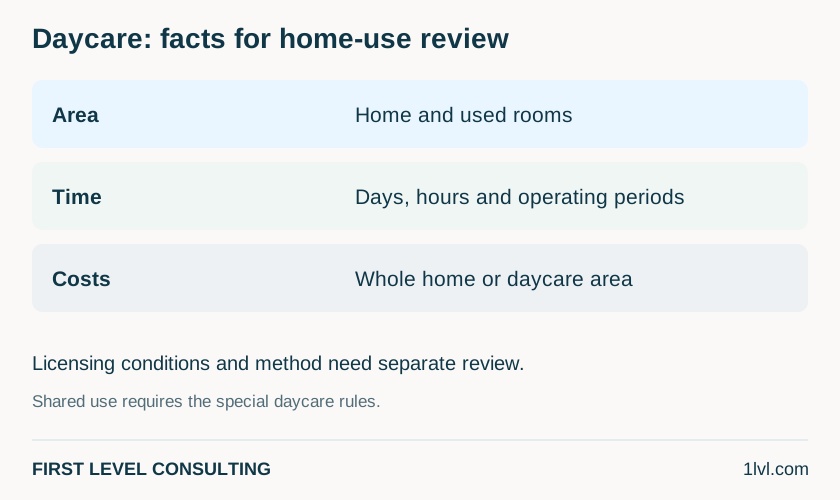
Qualifying daycare has a special exception to the usual exclusive-business-use requirement. Conditions include business operation and required licensing, application or exemption. Shared family space may require a time allocation. This does not automatically make the whole home deductible.
Prepare total home area, each used area with measurements, periods of use, and rent/ownership details. Separately collect mortgage interest or rent, property tax, insurance, utilities, repairs and improvement documents. Identify whether each cost relates to the whole home or only the daycare area.
Meals: records first, calculation method second
Gather breakfasts, lunches/dinners and snacks served to eligible children, plus receipts when using actual costs. Keep food-program payments separate from food costs. Exclude family purchases and the owner’s meals from recipient meal records.
Eligible providers may use standard meal and snack rates instead of actual costs. Rates depend on year and location; eligibility and method are reviewed separately. Do not automatically apply the ordinary business-meal limit to recipient food or combine both methods for the same meals.
Other costs, workers and assets
Gather toys and supplies, training, business insurance, licensing, software, advertising and professional-service records. For a vehicle, retain mileage and the purpose of business trips. Separate home-use costs from costs unrelated to using the home.
For helpers provide agreements, duties and payroll or contractor-payment records for status review. For furniture, play structures, computers and other assets, gather purchase/in-service dates, cost, personal use, prior depreciation and disposal records. Do not enter an asset purchase both as an ordinary cost and depreciation.
Review the package and share securely
If you are new to First Level, provide the latest complete filed return and, when available, the last two years. Include federal and state returns, all schedules, asset/depreciation schedules and carryovers. Tell us when a return is unavailable instead of guessing.
Use the secure channel assigned by our team, TaxesToGo or your personal Egnyte link, including for a scope and fee estimate. Downloading Excel does not send us your information. Do not attach completed organizers, tax forms or identification details to your initial email or SMS.
What to prepare for a discussion
- Business structure, address, operating dates and licensing records.
- All receipts, refunds, subsidy and food-program statements.
- Attendance calendar, hours, area and periods of home use.
- Meal counts, previously used method and cost support.
- Costs, helper/payroll records, assets and complete prior returns.
Questions and answers
I am a nanny for one family. Is this my workbook?
First establish employment status. A household worker does not become a daycare business owner simply by caring for children.
Our family also uses the room. Is a deduction impossible?
Qualifying daycare has special rules. Gather licensing facts, area, hours and costs so eligibility and calculation can be reviewed.
Will Excel show my exact tax?
No. It organizes records and preliminary amounts. Tax, method selection, limitations and depreciation are reviewed in the return.
Official sources
- California CDSS — child care licensing and family child care homes www.cdss.ca.gov
- IRS Publication 926 — household employees www.irs.gov
- IRS Publication 587 — daycare, home use and meals www.irs.gov
- IRS Publication 334 — business income, expenses and inventory www.irs.gov
- IRS Publication 946 — depreciation and asset records www.irs.gov