A W-2 company driver, an owner-operator leased to a carrier and an own-authority business need different records. Start with your role and agreements, then organize earnings, deductions and expenses. A net bank deposit alone does not show business profit.
Use this guide to prepare records for 2025 or 2026. The annual workbook organizes income-tax information; it is not a quarterly IFTA return, IRP application, ELD or dispatch system. Attach useful reports you already have instead of retyping every transaction.
Identify your role before choosing an organizer
Own authority and leased-on describe operations, not tax classification. An LLC may report through its owner’s Schedule C or under other rules, including a corporate return. Multiple trucks in one business do not automatically require multiple Schedule Cs.
An ordinary W-2 company driver should not put employment expenses on Schedule C. Federal treatment of unreimbursed employee expenses differs from state rules. Published 2025 California instructions allow a separate employee-expense review on Schedule CA; final 2026 forms and rules need their own check.
| Your role | Start with |
|---|---|
| Company driver · W-2 | W-2, pay statements, employer reimbursement/per-diem policy, and your own expenses for state-rule review. |
| Owner-operator · leased-on | Complete carrier settlements, carrier lease, 1099s, chargebacks, escrow accounting and fuel-card statements. |
| Owner-operator · own authority | Customer/broker invoices, factoring statements, receipts, expenses, equipment and operating reports. |
What to download or request
Create a tax-year folder with Income, Expenses, Trucks & trailers, Trips & fuel and Prior returns. Keep each business/entity separate and identify personal purchases.
Carriers, factoring companies, fuel-card providers and ELD/telematics services use different portals. Request or export reports for the exact dates needed. Save complete PDFs and available CSV/Excel detail supporting annual totals.
Carrier / dispatch / broker
Get every settlement, available annual summary, issued 1099, agreement, itemized chargeback report and escrow ledger with opening and closing balances.
Bank / cards / factoring / fuel provider
Save all monthly statements, factoring reports, fuel transactions and receipts. Use lender statements to separate principal from interest.
ELD / telematics / trip records
Export routes, dates and jurisdiction distance before older history is deleted. Include your trip/meals log and reimbursement information.
Truck / trailer / registration
Collect purchase invoices, financing and lease agreements, IRP/IFTA records and Form 2290 with its stamped Schedule 1 when applicable.
Reconstruct settlement gross before deductions
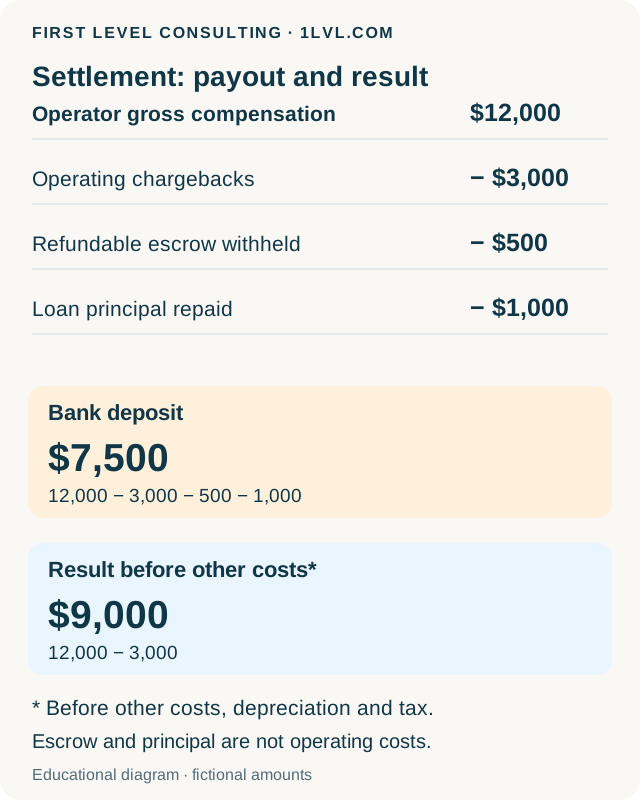
For a leased-on operator, gross means compensation owed to that operator under the agreement before chargebacks. Under a percentage arrangement it is not necessarily the entire shipper invoice. Separate linehaul, fuel surcharge, detention and other accessorials, and reconcile them to the agreement and annual summary.
A 1099 can describe the same freight already included in settlement totals. Do not automatically add it as more income. Explain differences in dates, adjustments and carrier deductions.
Refundable escrow deposits and releases, advances and principal repayments need separate reconciliation. Money withheld is not always a current expense, and money returned is not always new income. Factoring proceeds must also be reconciled to invoices rather than counted as another sale.
| Settlement item | How to prepare it |
|---|---|
| Gross compensation | Operator compensation before deductions, not just the net deposit. |
| Operating chargebacks | Itemized expenses with supporting records. |
| Escrow withheld / released | Separate ledger, agreement terms and balances. |
| Advances / loan principal | Separate reconciliation, not an automatic deductible expense. |
| Net payout | Match the settlement to the bank deposit. |
Separate carrier-withheld costs from separately paid costs
Use two columns for each category: withheld in settlements, and paid separately but not already included. Fuel already charged through a settlement should not be entered again from a fuel-card statement. A receipt and statement can support one expense.
Record amounts and descriptions instead of trying to decide every deduction limit yourself. Personal costs, fines, long-term asset purchases, principal and refundable escrow should not automatically flow into ordinary deductible expenses.
| Group | Records to collect |
|---|---|
| Truck operating costs | Diesel/other fuel, DEF separately, repairs, maintenance, tires and washes. |
| Insurance / equipment | Cargo, liability, bobtail, physical damage, equipment rental/lease and agreements. |
| Trip / carrier / broker | Factoring, dispatch, lumper/loading, tolls, parking and scales; reimbursements separately. |
| Compliance / office | Permits, registration/IRP, Form 2290, IFTA tax/credits for review, ELD, load boards, software, accounting and business communications. |
| Financing / assets | Interest separate from principal; trucks, trailers and improvements in the asset register. |
Meals and per diem: establish eligibility before using a rate
Travel-meal rules begin with your tax home, generally your main business area rather than automatically your family residence. Travel away from it must require sleep or rest. Sleeping in a truck alone does not establish eligibility; an itinerant without a tax home may not have an ordinary away-from-home deduction.
The 80% limit for eligible DOT meals depends on a qualifying hours-of-service duty period. It does not apply to every grocery purchase, every road day or lodging. Separate ordinary business meals, qualified transportation meals and employer/carrier reimbursements. For actual meals, provide 100% of the amount paid rather than reducing it yourself to 80% or 50%.
Special transportation M&IE is an eligible method of measuring an expense allowance. CONUS $80 and OCONUS $86 are not refunds or automatic daily deductions. Do not combine actual meals and per diem for the same days. Choose and apply an allowable method consistently throughout the year. Self-employed lodging requires actual expense records.
Departure and return days require permissible proration, commonly 75% or another reasonable consistent method. Choosing the special transportation rate requires consistent use across the year’s trips. Provide dates, destinations, full/partial days, tax-home facts and reimbursements rather than treating all calendar days as qualified.
| Source period | Special transportation M&IE |
|---|---|
| From October 1, 2024 · Notice 2024-68 | CONUS $80 / OCONUS $86 |
| From October 1, 2025 · Notice 2025-54 | CONUS $80 / OCONUS $86 |
| From October 1, 2026 · Notice 2026-60 | CONUS $80 / OCONUS $86 |
Track tractors and trailers as separate assets
For a heavy tractor, collect actual operating costs and asset documents. Do not automatically apply an automobile cents-per-mile formula to a heavy truck. Distance records still matter for operations, jurisdictions and use verification.
List tractors and trailers separately, including older assets already depreciated. Provide unit/VIN, purchase and placed-in-service dates, cost, tax/freight, improvements, business use and purchase/finance/lease agreements. Identify sales, trade-ins, damage and retirement from service.
A financed-truck payment includes different components: principal is not automatically a current expense, interest is reviewed separately and the asset cost follows depreciation rules. A lease-purchase agreement needs a contract review. Buying equipment does not guarantee a full write-off; federal elections and California rules may differ.
- Attach the prior depreciation/fixed-asset schedule, not just the truck’s name.
- For a sale or trade-in, provide dates, proceeds, documents and prior depreciation.
- Identify amounts already included in settlements or another workbook to prevent duplication.
ELD, IFTA, IRP and income tax serve different purposes
IFTA concerns fuel-use tax, IRP concerns apportioned registration, and income tax concerns business earnings and allowable expenses. IFTA taxable/exempt miles are not automatically business/personal miles for income tax. The annual organizer is not a substitute for filing-specific templates.
Keep complete power-unit distance records: dates, origin/destination, route, odometer/ECM, total distance and distance in each jurisdiction. Loaded, empty, deadhead and bobtail movements matter, not only paid miles. ELD exports are helpful but do not replace receipts or sufficient underlying data.
Fuel receipts need the date, vendor/address, quantity, fuel type, unit, purchaser and unit price or total. Track DEF separately: collect its cost as a separate category, but exclude DEF gallons from IFTA fuel gallons and fuel MPG.
For leased-on work, check the agreement to establish whose IFTA license covers the unit, who files and who pays. It is not automatically the carrier or the owner. Any quarterly IFTA responsibility is separate from annual income-tax preparation.
| Purpose | Core records |
|---|---|
| Income tax | Gross and expenses, business purpose, personal allocation, assets and support. |
| IFTA | Jurisdiction distance, qualified-vehicle fuel and the agreement assigning responsibility. |
| IRP | Complete distance history for apportioned registration and vehicle records. |
Form 2290 has its own weight threshold and tax period
Form 2290 generally applies to a highway motor vehicle with a taxable gross weight of 55,000 pounds or more. IFTA’s separate weight/axle and interjurisdictional criteria do not determine Form 2290 treatment.
Collect the stamped Schedule 1, EIN/VIN, taxable gross weight, first-used month, period and payment or suspension records, as applicable. Form 2290 can cover July through June, rather than the calendar income-tax year. Review changes in use, sales and low-mileage suspension under the applicable instructions.
Export early: retention periods are different
FMCSA’s six-month ELD/RODS retention minimum does not mean tax records can all be deleted after six months. IFTA, IRP, income tax, assets and open examinations can require longer retention. Keep regular exports outside a single provider account.
Asset and depreciation records can be needed throughout ownership and for the applicable period after disposition and reporting. Income-tax retention depends on the facts; do not use one universal destruction date for the entire archive.
| Records | Verified retention reference |
|---|---|
| FMCSA RODS / supporting documents | 6 months from receipt. |
| IFTA supporting records | Generally 4 years from the due date or actual filing, whichever is later; extensions can apply. |
| California IRP distance | 3 years after the registration year ends. |
| California IRP vehicle cost/weight | 4 years after the registration year in which the vehicle was deleted. |
Final checks before secure handoff
Reconcile year-to-date totals to complete settlements, 1099s and bank deposits. Identify missing months and items needing review. The annual organizer separates carrier-withheld costs from additional costs paid directly.
New clients need the latest complete filed return and, when available, the last two years: federal, states, all schedules, depreciation/asset schedules and carryovers. Tell us if this is your first return or prior records are unavailable.
Send the workbook and records through the secure channel assigned by our team, TaxesToGo or your personal Egnyte link, including for a scope and fee estimate. Do not attach completed worksheets, EIN/VIN records or tax forms to your initial email or SMS. This organizer supports annual income-tax preparation. Discuss IFTA, IRP and other filings separately with an appropriate specialist.
What to prepare for a discussion
- W-2 / leased-on / own-authority role, entity information and agreements.
- All settlements, annual summaries, 1099s, factoring and bank statements.
- Carrier-withheld and separately paid costs, escrow ledger and finance statements.
- Truck/trailer register, purchase/lease/sale documents and prior depreciation schedule.
- Trips/meals, reimbursement and ELD/distance/fuel exports; applicable IFTA/IRP/2290 records.
- Estimated tax payments and the latest complete return; two years when available.
Questions and answers
I am a W-2 company driver. Do I need a Schedule C organizer?
Do not move wages and employment expenses to Schedule C because of your job. Provide W-2, reimbursement/per-diem records and expense information for federal and state review.
Can I use settlement net as all my income?
Net already reflects deductions with different treatment. Provide gross compensation and itemized chargebacks, escrow, principal and other adjustments.
Does everyone sleeping in a truck qualify for per diem?
No. Tax home, away-from-home sleep/rest, applicable HOS and other conditions must be reviewed. A published rate does not create eligibility.
Do multiple trucks require multiple files?
One business can track several units within one organizer, with separate assets. Separate businesses and entities need a tax-structure review.
Can this workbook be filed as an IFTA return?
It is an annual income-tax organizer. IFTA filing needs separate jurisdiction records and the agency’s applicable format. Retain underlying reports and the agreement assigning responsibility.
Official sources
- IRS Topic 511 — business travel expenses www.irs.gov
- California FTB — 2025 Schedule CA instructions www.ftb.ca.gov
- 49 CFR 376.12 — lease compensation, chargebacks and escrow www.ecfr.gov
- IRS Publication 334 — business income and expenses www.irs.gov
- IRS Publication 946 — depreciation and business assets www.irs.gov
- IRS Publication 463 — travel, meals, car expenses and records www.irs.gov
- IRS Notice 2024-68 — transportation M&IE from October 2024 www.irs.gov
- IRS Notice 2025-54 — transportation M&IE from October 2025 www.irs.gov
- IRS Notice 2026-60 — transportation M&IE from October 2026 www.irs.gov
- CDTFA Publication 50 — IFTA, distance and fuel records cdtfa.ca.gov
- CDTFA — IFTA reporting, records and templates cdtfa.ca.gov
- California DMV — IRP recordkeeping requirements www.dmv.ca.gov
- IFTA Inc. — carrier information and IFTA versus IRP www.iftach.org
- FMCSA — retention of RODS and supporting documents www.fmcsa.dot.gov
- IRS — Form 2290 instructions, July 2026 revision www.irs.gov