A Turo bank deposit does not show the whole story of receipts, costs and taxable profit. Collect annual platform documents, payment history and separate records for every vehicle. Buying a car and repaying a loan are also different from ordinary annual operating expenses.
This guide covers preparation of records for U.S. vehicle rentals. One business can operate several vehicles, organized in one workbook with separate vehicle records. If different people or entities own the cars, review the structure first. Sources were checked November 16, 2026; select the correct reporting year.
Turo does not automatically mean Schedule E
The IRS distinguishes real-estate rentals from personal-property rentals. Its guidance directs a business renting personal property to Schedule C, while nonbusiness personal-property rentals use the applicable Schedule 1 lines. Renting out a car does not make it real estate.
This is an individual-return starting point, not an automatic classification of your activity. Partnerships and corporations can require their own returns. Identify the vehicle owners, platform host/payee and taxpayer number on the documents. For an LLC, provide ownership and existing tax elections.
Download earnings, payment history and tax forms
Turo describes separate earnings and tax-information reports. Keep the original CSV and the full PDF of each issued tax form, rather than only a screenshot. Not receiving a 1099 does not replace keeping track of actual receipts.
A public Turo tax page may still show a deadline for the prior reporting year. Confirm the year on each document. In November, the current year has not ended: retain available history now and add final annual records and issued forms after year-end.
On the website, enter host mode and open Earnings
Use the account for the business. Turo supports downloading an earnings CSV through the web; check the period covered.
Save Transaction history
Use it to reconcile earnings, adjustments and transfers. Include bank statements showing the actual payouts.
Open Tax information
Save the annual earnings/payout summary and each available tax form. Check the payee, taxpayer number and year. Include corrected forms and an explanation.
In the app, use Business → Earnings
Use the website for the CSV download. If a period is missing or unavailable, request it through official support.
Why gross earnings and payouts differ
Turo explains that tax-information gross earnings and the earnings chart can contain different components. Do not transfer bank net or one dashboard chart into a return without checking the annual Tax information.
For each car, collect trip earnings, incentives, fees, refunds and adjustments. Identify reimbursements and platform-handled taxes separately. Follow the definitions in the report for the relevant year so the same platform charge is not added to receipts again or deducted twice.
A 1099, annual summary and CSV can describe overlapping transactions. Note which total already includes another amount. If the records do not reconcile, flag the difference and provide the originals instead of silently changing a reported figure.
| Record | Purpose |
|---|---|
| Tax information / issued 1099s | Annual tax totals and platform information reporting. |
| Earnings CSV / trip details | Trip, vehicle and component detail. |
| Transaction history / bank | Payout and adjustment reconciliation. |
| Receipts and agreements | Costs, ownership and financing support. |
Reimbursements, damage claims and deposits
Keep a separate reimbursement ledger for fuel/charging, tolls, cleaning, damage and other items. Record the trip, vehicle, date, payment and matching receipt. Identify whether the amount appears in platform gross earnings or payouts.
Do not assume every reimbursement is tax-free or retain a full expense deduction for a reimbursed item without review. Damage claims, insurance proceeds, lost-income compensation and ordinary expense repayments can require different treatment. Tell us when a repair shop received payment directly.
Identify refundable amounts and deposits with their conditions. For disputed payments, provide the platform decision and correspondence. Treatment depends on what the payment represents and the supporting facts, rather than only the bank transaction label.
Keep an individual record for every car
Start with every car used during the year, including vehicles sold, destroyed or temporarily removed from listings. Include an internal ID, VIN, make/model/year, legal owner, purchase date and the date first ready and available to rent.
Provide the bill of sale, invoice, acquisition taxes/registration, other purchase costs and financing agreement. A personal vehicle converted to business needs original cost and support for value at conversion. The outstanding loan balance is not automatically the tax basis.
Record ownership percentage, business-use changes and periods of personal use. The same car cannot have its full cost deducted by Turo and another business at the same time. If it also serves delivery or rideshare work, provide the complete use history so allocations can be reviewed.
Collect vehicle costs and shared business expenses
Separate insurance/protection, registration, current repairs, tires, washing, parking/storage, delivery costs, tracking devices and business services. When one invoice covers several cars, keep the allocation method with it.
Collect shared costs separately: advertising, website, accounting, software, telephone, premises and helpers. Do not repeat costs already captured through platform fees or bookkeeping imports. Exclude personal purchases or identify the business portion.
Put major restoration, improvements, added equipment and vehicle purchases in the asset register for review. Do not combine everything under repairs. A cost needs business purpose and supporting records; a dashboard profit figure does not replace invoices and other evidence.
Depreciation, financing and vehicle sales
For each car, supply prior depreciation schedules, basis, accumulated depreciation and elections if known. Recovery of purchase cost can involve depreciation or applicable expensing rules, depending on dates, use, asset classification and limitations.
Do not apply the rule that a loan payment equals an expense. Principal repays debt; interest is considered separately. A financed vehicle still needs its own cost and depreciation record. Keep loan statements that break out the payment components.
For a sale, provide the agreement, sale price, date, fees and payoff. Include all paperwork for a trade-in or insurance total loss. Proceeds less outstanding debt do not automatically measure tax gain: prior depreciation and adjusted basis are separate parts of the analysis.
Mileage and personal use
Retain beginning/end-of-year odometer readings, guest miles, your delivery/pickup and service travel, and personal trips. Booking history may not cover every use of the vehicle.
Do not automatically transfer a rideshare driver’s mileage method to a rental fleet. The availability and selection of vehicle-expense methods depend on the facts and prior accounting. Do not combine standard mileage with a second deduction for the same actual operating costs.
Even when actual costs are used, records of business and personal use support allocation. For idle periods, explain whether the vehicle remained available to rent, was under repair or was used personally. Retain evidence of listing and availability when useful.
Cash remaining and taxable profit answer different questions
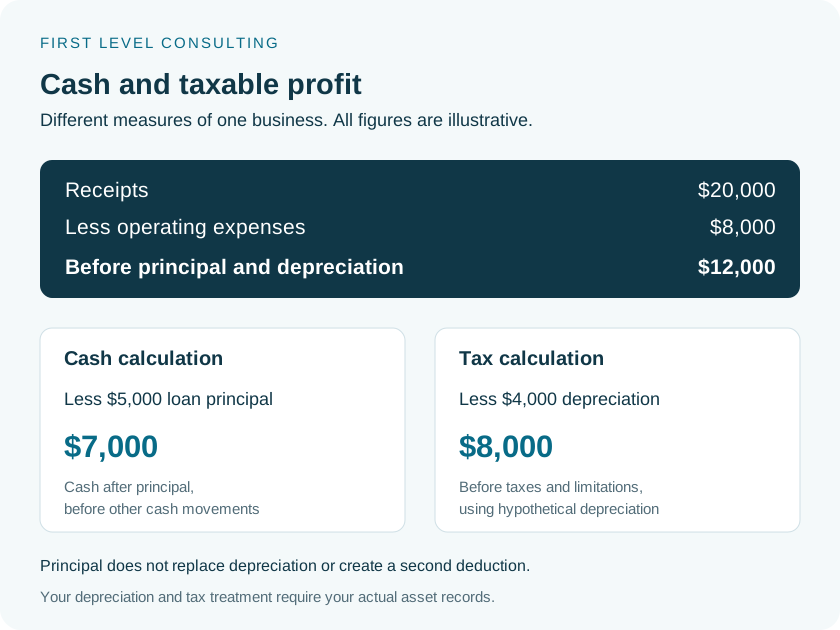
The organizer should help show the result after the operating costs you enter. A bank balance, cash flow after debt principal and the tax result after depreciation measure different things.
For illustration, $20,000 of receipts minus $8,000 of operating expenses leaves $12,000 before depreciation. Paying another $5,000 of principal reduces available cash, but principal does not become a new current deduction. Depreciation calculated from the asset records is considered separately.
These figures do not establish your deduction. Leave unknown depreciation unfilled and provide records. A preliminary business result is not an amount you can necessarily withdraw without personal tax, limitations or other obligations.
Prepare the First Level handoff
Reconcile the whole business, then review each vehicle and shared costs. Flag missing months, payee differences, additions/disposals, reimbursements and unknown amounts. Useful bookkeeping reports can replace manual transaction entry.
New clients need the latest complete filed return and, when available, the previous two years with all schedules, states, depreciation and carryovers. Form 1040 alone does not reconstruct the vehicle history.
Send the organizer, VIN/EIN information and tax forms through the secure channel assigned by our team, TaxesToGo or your personal Egnyte link, including for a scope and fee estimate. Your initial email or SMS can request the secure link without attaching client tax documents.
What to prepare for a discussion
- Earnings CSV, Transaction history, annual Tax information and all issued 1099s.
- Gross/fees/payout reconciliation and refund, incentive, reimbursement and claim explanations.
- Individual vehicle register, VIN, owner, acquisition and ready-for-rental dates.
- Interest versus principal, financing/lease/purchase/sale/total-loss documents.
- Vehicle costs, shared costs and business/personal-use records.
- Prior depreciation schedules and complete returns for the latest one–two years.
Questions and answers
Does Turo always belong on Schedule E?
No. A car is personal property. The IRS distinguishes a personal-property rental business from nonbusiness rental activity; an entity can require a separate return.
Do five cars require five Schedule Cs?
Not automatically. One rental business may operate multiple cars. Keep individual vehicle records and discuss separate businesses or owners with the preparer.
Can I use bank deposits as my entire income?
They start the reconciliation, but fees, adjustments and other components can make payouts different from gross earnings. Provide platform records.
Can I deduct the entire purchase or every loan payment?
Do not automatically enter either as an ordinary expense. Acquisition cost, principal, interest and depreciation have different treatment.
If the sale price is below the loan payoff, is there no tax gain?
The outstanding debt does not determine tax gain by itself. Adjusted basis, prior depreciation and sale documents are needed.
Official sources
- Turo — viewing earnings, transaction history and CSV downloads help.turo.com
- Turo — U.S. host tax information and gross-earnings definitions turo.com
- IRS Topic 414 — personal-property rentals versus real-estate rentals www.irs.gov
- IRS Publication 334 — business income and expenses www.irs.gov
- IRS — business recordkeeping www.irs.gov
- IRS Publication 583 — starting a business and keeping records www.irs.gov
- IRS Publication 946 — depreciation and asset dispositions www.irs.gov
- IRS Schedule C instructions — expense categories and supporting schedules www.irs.gov
- IRS Publication 463 — vehicle methods and business-use records www.irs.gov